
PERFORMANCE AND DOCUMENTATION
Body suspension and live performance: reading a show
Body art and live performance: suspension, dramaturgy, music, light and audiences. Documented examples, Body Art Night and performance records.

Suspension as a stage composition
A public suspension performance combines bodies with time, space, spectators, sound and light. Its artistic task differs from a personal session. [BXINTRO] Examples include Hilary Whitmore’s Operafication, combining opera, dance and suspension, and Altered States’ planned multi-part Body Art Night. [POINT54] [AS26]
Seeing an action within its setting
Begin with the whole situation: body suspension in live performance can be viewed through relationships between body, setting, duration, sound and audience. Performance artist Stelarc’s documentation offers a specific example involving movement and sound elements. [S1] It does not supply a single interpretation for every work using a related medium.
First establish the title and context. Is this a standalone action, part of a larger programme or documentation made for later presentation? Each setting can shape attention and description. Introducing the artist identifies whose choices organise an image. Keep the work’s title and creator visible so later interpretation has a clear reference in the material being discussed.
Photographer Łukasz Ratajczyk preserves a Polish example. His 20 February 2011 post describes the previous day’s Tattoo Festival at Dekompresja in Łódź and identifies Altered States Crew. He reports two performers using a shared platform. This is evidence for a particular work and the photographer’s viewpoint, not every show by the team. [PRLODZ11]
Time and dramaturgy
From the setting, turn to progression: a photograph freezes a moment, while watching an entire action allows attention to its beginning, development, changing rhythm and ending. Silence, repetition and stillness can also direct attention, although their significance in a particular work needs interpretation.
Describe the sequence before evaluating it. What happened next? When did light or the audience relationship change? Identify your own associations as your own, leaving room for the performer’s different account. Dramaturgy means the organisation of these relationships through time. A viewer can first identify repetition or a change of pace, then consider what it might mean.
Victoria Hawkins’s account of Hilary Whitmore’s Operafication in The Point 54 offers another example. At the BMXnet conference in Berlin in 2010, it combined opera, contemporary dance and suspension, with red ribbons visually connecting the suspended performer and dancers. This provides a particular composition of movement, voice and image. [POINT54]
Comparing Łódź’s two-person platform work with Operafication reveals two stage relationships. The first account emphasises suspended bodies together; the second adds a singer’s relationship with dancers and music. This is an editorial comparison of documented compositions, without ranking the works or inferring performers’ internal experiences. [PRLODZ11] [POINT54]
Artistic intention and participant experience
Questions of meaning lead to participants’ voices: some interviewees in sociologist Katarzyna Kowal’s study described suspension as artistic expression and an invitation to reflection. [K16] These are particular participants’ accounts, not a definition for every person or event.
A facial expression cannot reliably establish someone’s internal experience. Questions should allow a person to decline. A viewer’s reaction likewise does not automatically establish artistic intention. Keeping these perspectives separate makes discussion more precise. The same event can invite accounts of intention, sensation and reception. Naming the perspective preserves differences rather than expecting one account to explain everyone’s experience.
These choices can be compared with Stelarc’s performances in different spaces.
From artistic proposal to programme: Body Art Night
These different perspectives also matter during preparation: the following are editorial suggestions for organiser–performer conversations. Discuss the presentation’s aim, position within the programme, available time and collaborators’ roles. Establish who introduces the work and coordinates communication.
Discuss audience interaction, photographers’ presence and the possibility of changing or ending the action. These agreements belong to a particular collaboration. A historical description is not a complete plan for present-day execution, which requires a competent team and separate preparation.
The original announcement for Body Suspension Wrocław 2026 supplies an Altered States project proposal. It planned ten suspensions within a shared composition of light, sound and Vortex Visual Division scenography on 14–16 August. Public Body Art Night was scheduled for 15 August, with the other days described as more closed working sessions. This is an announcement of an Altered States project, describing its planned form. [AS26]
The Body Art Night 2026 announcement also requested advance discussion of music and individual performance form before the Wrocław gathering. Within this proposal, composing the stage image began before the event itself, and participants were to enter a coordinated overall project. This describes the announced working concept. [AS26]
The audience within the situation
Agreed collaboration leads to another question: discuss viewing positions, movement through the space and how photography rules will be communicated. Distance, visibility and audibility concern both artistic reception and event organisation.
An introduction can describe form and authorship without prescribing a sensation. Brief information about the presentation lets viewers decide whether to attend; there is no need to promise a shared emotional response or a particular altered state.
What should an organiser clarify before a show?
Clarify the event format, audience, space, schedule, sound, light and the responsibilities of venue and team. Body Art Night 2026 proposed discussing music and individual forms before arrival, with ten suspensions composing a shared project. [AS26]
A stage role is more than body orientation
Operafication linked suspension to opera, dance and red ribbons, while Shadow Suspension composed six suspended people. [POINT54] [SHADOW13] A programme can focus on synchronised movement, duration, stillness, weight or relationships rather than requiring a narrative plot.
Parasite: not every image of Stelarc is suspension
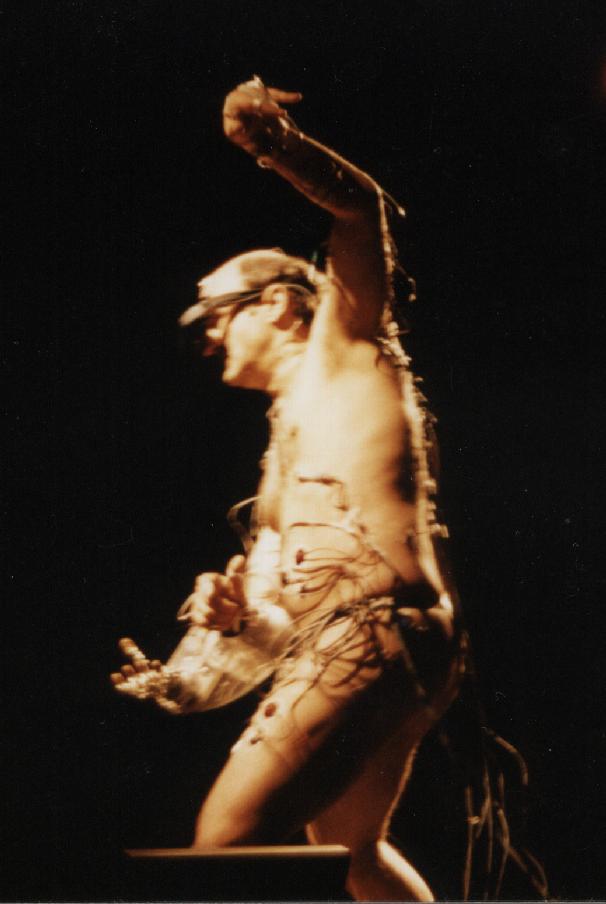
The source photograph used here shows Parasite at Ars Electronica in 1997. Stelarc describes Parasite as a performance in which internet data animated the body, separate from his suspension series. It illustrates body art’s wider questions of embodiment and agency rather than a single technique. [PARASITE97]
When writing an event description, identify the work and medium before choosing keywords. A live act, installation, performance recording and film screening are not interchangeable. Specific wording helps audiences understand what is offered and organisers describe the agreed scope.
Practical takeaway
The medium alone does not explain the work. Context and participants’ voices matter.
For participation enquiries, distinguish a private session, workshop and performance so that the format and role can be discussed clearly.
Key point: The medium alone does not explain the work. Context and participants’ voices matter.
Sources and further reading
- Suspensions — Stelarc. Artist’s project documentation.
- W poszukiwaniu siebie. Indywidualne motywy podwieszania ciała praktykowanego współcześnie w Polsce — Katarzyna Kowal. 2016. Qualitative research; 30 repeat practitioners. Full local PDF · CC BY 4.0. Publisher PDF.
- Body Art Night – Body Suspension Wrocław 2026 — oryginalna zapowiedź — Altered States Suspension. 2026. Altered States original announcement; planned dates 14–16 August 2026.
- The Point 54: APTPI Italian SusCon; BMXnet Berlin — APTPI Office; Elayne Angel / The Point. 2011. Trade-community reports, Winter 2011, p. 15 (APTPI) and pp. 19–20 (BMXnet).
- Altered States Crew | Susspension na Tattoo Festival 2011 — Łukasz Ratajczyk / WYTWORNIAKADROW.pl. 2011. Photographer’s report published 20 February 2011, describing the previous day.
- Bio notes — Parasite (1997) — Stelarc. Artist’s biography: Parasite is a separate internet-data work, not suspension.
- Suspension — opis praktyki, doświadczeń i pytań uczestników — Body Extreme Tattoo & Piercing. Organiser’s own account of experience and private versus public events.
- Shadow Suspension — Stelarc & Håvve Fjell — Stelarc. 2013. Artist’s documentation: Dallas, 30 March 2013, with separate team credits.