
RESEARCH LIMITS
Pain, focus and consciousness in body suspension
Body suspension, pain and awareness: participant accounts, cortisol and flow research, and what these findings can and cannot establish.
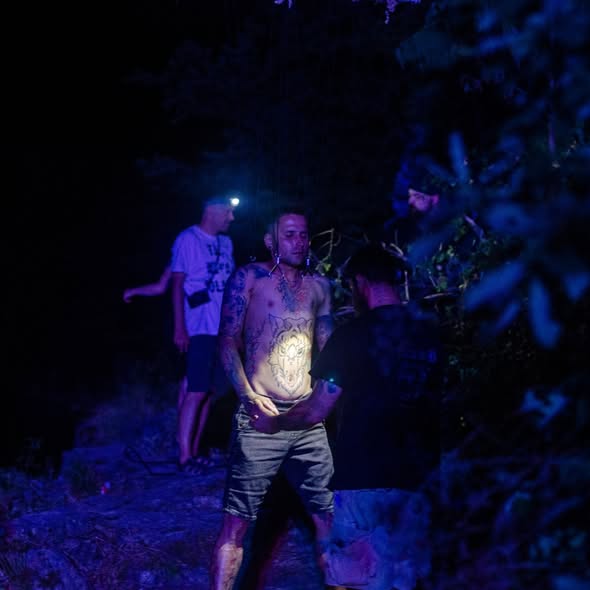
Before lifting, airborne and afterwards
Pain is one aspect of suspension rather than a complete description. Accounts include anticipation, tension, concentration, changed sensations of weight, pleasure and subsequent quiet. Different stages can feel different. [K18] Another person’s experience cannot predict yours; Dance of Souls measurements concern a related activity. [L16]
An experience unfolds over time
Katarzyna Kowal’s sociological research on suspension offers a way beyond the single photograph. Her 2018 article examines accounts of pain and pleasure across the experience. [K18] The material is narrated: participants’ words, rather than sensations measurable from an image. Reading it allows attention to anticipation, changing awareness and the meaning of a memory. It therefore expands the questions we can ask without converting a detailed account into an objective measure of another person’s feelings.
Begin a preparatory conversation with what remains uncertain. Is the concern the image, an audience, communicating needs or an expected emotional response? These questions help organise discussion without predicting what someone will feel.
Pain is not a comparative score
Because accounts concern personal experience, they should not become a comparative score. Duration, a striking image or a calm expression cannot set a target for the next participant. Comparison can redirect attention from personal needs towards an external expectation. A preparatory discussion is better used to clarify how uncertainty, discomfort and a wish to end will be communicated than to establish whether someone can match another person’s story of endurance.
Agree how discomfort, uncertainty and a wish to stop can be communicated. A person need not find perfect words or justify a need through someone else’s account. Clear communication arrangements and scientific explanations of pain answer different questions.
In conversations with Manfredi, José did not describe all modifications as one kind of pain. He recalled tattooing his foot, while distinguishing meanings within tattooing, piercing, scarification and suspension. Sometimes he understood pain as a limit he wanted to confront; at other times he emphasised unfamiliar sensations and what followed the experience. Manfredi does not turn this into a ranking of how painful the techniques are. The account shows that even for one person, the meaning of pain depended on the situation and intended purpose (p. 14). [M23]
Focus, trance and perception
Descriptions of pain lead into attention and perception: how a situation is felt and experienced. Focus, trance and disconnection can be attempts to convey something difficult to express otherwise. Ask whether the speaker means emotion, attention, memory or later interpretation. A shared word does not establish identical sensations. It begins a conversation; the person’s explanation connects that word to the particular aspect of experience they are trying to describe.
Kowal distinguishes attention to the body’s external image from attention directed towards its lived interior. Interviewees described the surroundings receding and their own sensations becoming central. She interprets this as an intensified relationship with the body, not literally becoming disembodied. Escape therefore names a way of experiencing the self rather than a finding that a person leaves their organism (pp. 88–89). [K16]
Maria, one of Manfredi’s three central cases, described a mind that felt simultaneously full and empty and a return to the everyday world when her feet touched the ground. The author develops sensory-poiesis: self-making through extraordinary sensory experience. She distinguishes meanings concerning the self, relationships with others and the environment. This interprets narratives rather than establishing a clinical scale or diagnosing trance (pp. 18–20). [M23]
The measurements are contextualised in the Dance of Souls study and its participant selection.
What do hormonal explanations establish?
Hormonal language is one further way people explain sensation. Federica Manfredi’s ethnographic research on suspension and other modifications records community explanations rather than measurements she performed. [M23] Her work helps us understand these explanations as part of participants’ narratives. In the material checked, we did not locate an experiment establishing that mechanism for airborne hook suspension itself. This marks our review’s scope, not a conclusion about every study that might exist.
When a text mentions endorphins or adrenaline, ask which publication measured what. Did it examine the same activity? Scientific terminology alone cannot explain an individual response or predict how a future event will unfold.
Salivary cortisol was measured before, during and after Dance of Souls. Complete three-sample sets came from 18 pierced and 25 non-pierced participants. Cortisol rose from before to during the event and then fell in the pierced group; in the non-pierced group it was highest beforehand and subsequently declined. This concerns cortisol in this setting, not endorphin or adrenaline measurements during airborne suspension (pp. 9–10). [L16]
Editorial analysis: Lee’s results also distinguish experienced stress from a physiological indicator. Among pierced participants, cortisol rose from before to during the event; self-reported stress was compared in questionnaires before and after the Dance. Its decline should not be presented as a measurement of feelings at the exact moment cortisol was highest. These are different variables observed over different time windows within Dance of Souls. They do not establish each person’s stress at every moment or the same pattern during airborne suspension (pp. 9–11, 19–20). [L16]
Dance of Souls: stress, flow and different roles
Questions about measurement lead to Lee and colleagues’ study of altered states during Dance of Souls. Participants danced with temporary piercings and hooks or weights; the study did not isolate airborne whole-body suspension. [L16] We turn to this paper to see how a method defines the reach of a finding. Its complete local copy allows readers to inspect the actual activity, rather than assuming equivalence from similar images or a shared vocabulary of ritual.
Flow, or absorption in an activity, was assessed differently. After the event, 69 participants answered a 36-item questionnaire about their feelings during the Dance. Both groups scored above the neutral midpoint, without a significant overall difference between pierced and non-pierced participants. This was retrospective reporting, not a before-and-after comparison of flow levels (pp. 8–9, 20). [L16]
The Dance of Souls study used Stroop tests before and during the event: identifying font colour despite a distracting word meaning. Of 83 enrolled participants, 59 completed both tests: 35 pierced dancers and 24 non-pierced people. Interference increased across the analysed sample, with no significant difference in that change between the groups. This was a cognitive task, not brain imaging (pp. 6–7, 19). [L16]
Music, silence and another person’s presence
Kowal’s participants described favourite music as supporting focus and easing anticipation; others wanted quiet or limited contact (p.105). [K18] Manfredi also describes eye contact, silence and presence. Support need not mean talking or encouraging someone to continue; it can mean respecting their choices (p.8). [M23]
Ending the session and what may follow
Returning pain, fatigue or reduced comfort were reasons for ending, with participants signalling their wish to come down (p.111). [K18] Afterglow described subjective calm or satisfaction, without endorphin measurements. Scars could be valued as a memory or disliked aesthetically; neither their appearance nor personal meaning can be promised (pp.112–115). [K18]
Stopping a performance takes priority over the programme
The artist’s record of Spinning / Breathing in Oslo in 2012 includes a fact that a still photograph cannot convey: the work ended after a participant lost consciousness. It describes five suspended bodies and amplified breathing. This is a documented artistic event, not an incidence study or proof of the event’s cause. [BREATHING12]
Writing about pain or altered perception should leave room for stopping, changing the plan and declining further participation. Nobody has to describe an unpleasant experience as a breakthrough. When watching a film, ask whether it shows the sequence or selected edits. Joy and difficulty can belong to the same account without either being erased.
Practical takeaway
Reported experience is not a hormone measurement or evidence of health benefit.
For participation enquiries, distinguish a private session, workshop and performance so that the format and role can be discussed clearly.
Key point: Reported experience is not a hormone measurement or evidence of health benefit.
Sources and further reading
- Między ziemią a niebem… Doświadczanie własnej cielesności przez osoby praktykujące podwieszanie ciała – studium socjologiczne — Katarzyna Kowal. 2018. Qualitative research; purposive sample of 30. Publisher PDF.
- Altered States of Consciousness during an Extreme Ritual — Ellen M. Lee i współautorzy. 2016. Dance of Souls; not a study of airborne hook suspension. Full local PDF · CC BY 4.0.
- Thinking the Self through Hooks, Needles, and Scalpels: Body Suspensions, Tattoos, and other Body Modifications — Federica Manfredi. 2023. Ethnography; three cases from a larger project. Full local PDF · CC BY 4.0.
- W poszukiwaniu siebie. Indywidualne motywy podwieszania ciała praktykowanego współcześnie w Polsce — Katarzyna Kowal. 2016. Qualitative research; 30 repeat practitioners. Full local PDF · CC BY 4.0. Publisher PDF.
- Spinning / Breathing: Event for multiple suspensions — Stelarc. 2012. Documentation of the Oslo work, including its termination following a participant’s loss of consciousness.